Summary: New York Knicks vs. Lakers blends NBA history, star power and tactical pressure in one of basketball
New York Knicks vs. Lakers remains one of the NBA’s most recognizable matchups, even when the two teams are separated by conference standings, playing styles and championship timelines. The rivalry carries the weight of Madison Square Garden。Hollywood, packed national television windows and decades of players trying to measure themselves against two of basketball’s biggest brands. When the Knicks face the Lakers, the game rarely feels like an ordinary regular-season date. Every loose ball draws a reaction from the crowd, every late whistle becomes a talking point, and even a routine first-quarter run can take on the atmosphere of a playoff warning.The history explains much of that intensity. The Knicks and Lakers met in three NBA Finals during the early 1970s, with New York winning in 1970 and 1973 while Los Angeles captured the 1972 championship. Those series featured contrasting basketball cultures: the Knicks relied on disciplined execution, physical defense and sharp passing。while the Lakers blended size, speed and star power. More than half a century later, the details have changed, but the emotional framework has survived. New York still expects toughness from its team, and Los Angeles still operates under the pressure that comes with being the Lakers. In a New York Knicks vs. Lakers game, old banners seem to sit quietly in the background, reminding everyone that reputations are earned over years but tested in a single night.The modern version of New York Knicks vs. Lakers is shaped by matchups rather than nostalgia alone. New York’s best stretches often come when its guards control tempo, its wings attack closeouts and its frontcourt players turn second chances into points. The Lakers, by contrast, can change the geometry of the floor through interior scoring。transition pressure and the attention demanded by their leading stars. That creates a tactical tug-of-war. If the Knicks slow the game and force Los Angeles into half-court possessions, their physical approach can become exhausting to defend. If the Lakers run after turnovers and make the contest a series of rim attacks, New York must protect the paint without surrendering open three-point attempts.
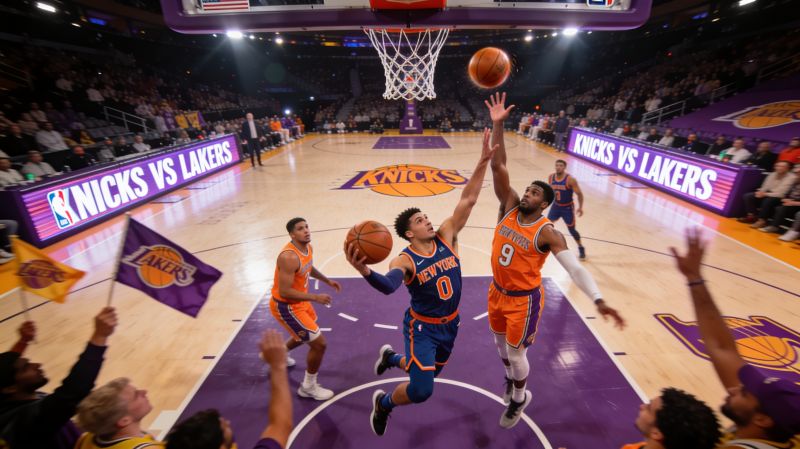
What makes New York Knicks vs. Lakers particularly revealing is the way role players can decide the result. A reserve guard who hits two early threes may pull a defense away from the lane. A veteran forward who takes charges can shift the mood inside the arena. The margin can be just as narrow in the final minutes: one offensive rebound, one missed rotation or one rushed pass against pressure. I have always found this matchup most interesting when the headline stars are not dominating every possession. The quieter battle often tells the story. Which team communicates better after a defensive breakdown?Who keeps composure when the crowd turns impatient?
Those details matter more than the pregame spectacle once the score tightens.For the Knicks, a strong performance against Los Angeles offers more than another win on the schedule;it provides evidence that their physical identity can travel and survive against elite talent. For the Lakers, beating New York carries its own value because the Knicks bring a demanding defensive tone and a crowd that treats every possession as a referendum on effort. That is why New York Knicks vs. Lakers continues to draw attention across the league, regardless of the teams’ records on a particular night. The matchup connects two cities that understand basketball as entertainment, business and civic pride at the same time. The uniforms are familiar, the pressure is immediate。and the smallest moments still have a way of becoming part of the rivalry’s long memory.